Sustainability in Lab Vacuum
Lab Vacuum Solutions by VACUUBRAND
The Problem:
- Vacuum is a widely-used utility in labs, but poses real challenges to sustainability objectives.
- Water aspirators used to produce vacuum can waste 40,000 gallons of water per year per sink, and contaminate it with waste biological and chemical vapors.
- Central vacuum systems typically run 24/7, so vacuum is always available on demand, but are typically in use less than 10 percent of available hours – wasting 90 percent of the energy used to operate them.
- Aspiration operations (e.g., for cell culture work) often lead scientists to leave vacuum ports open for extended periods, achieving convenience at the expense of wasteful use of vacuum pumping systems.
- Central systems are often overbuilt to achieve long-term building flexibility – vacuum supply wherever it might be needed in the future – but by installing pumping systems and piping networks much larger and resource-intensive than may be needed.
- Vacuum used for evaporative applications – ovens, concentrators, evaporators, gel dryers – generate waste vapors that are often simply discharged to the atmosphere through fume hoods and roof fans.
- Vacuum pumps themselves often rely on oil for sealing and lubrication. After contamination by lab vapors, oil must be changed and discarded regularly.
- Vacuum use is often uncontrolled, leading to inefficient processes that require longer than needed run times and generate excess heat and waste vapor.
Sustainable options for lab vacuum supply and use
Numerous options are available during lab construction, renovation and operation to address many of these challenges, so that lab vacuum supports rather than conflicts with sustainability objectives.
- Eliminate use of water aspirators: Water aspirators violate LEED standards for vacuum generation, and are prohibited in some states. Nonetheless, the low purchase cost continues to attract some users. Consider, however, that a lab building with 25 aspirators can avoid wasting and contaminating a million gallons of water per year. In many cases, water and treatment savings will pay for individual vacuum pumps as an alternative in as little as a year or two.
- Choose oil-free pumps when possible: Most lab applications can be supported by oil-free pumps. These pumps not only eliminate the oil consumption and environmental problems of contaminated waste oil disposal, but also provide vacuum at levels better suited to the most common lab operations (filtration, aspiration, evaporation).
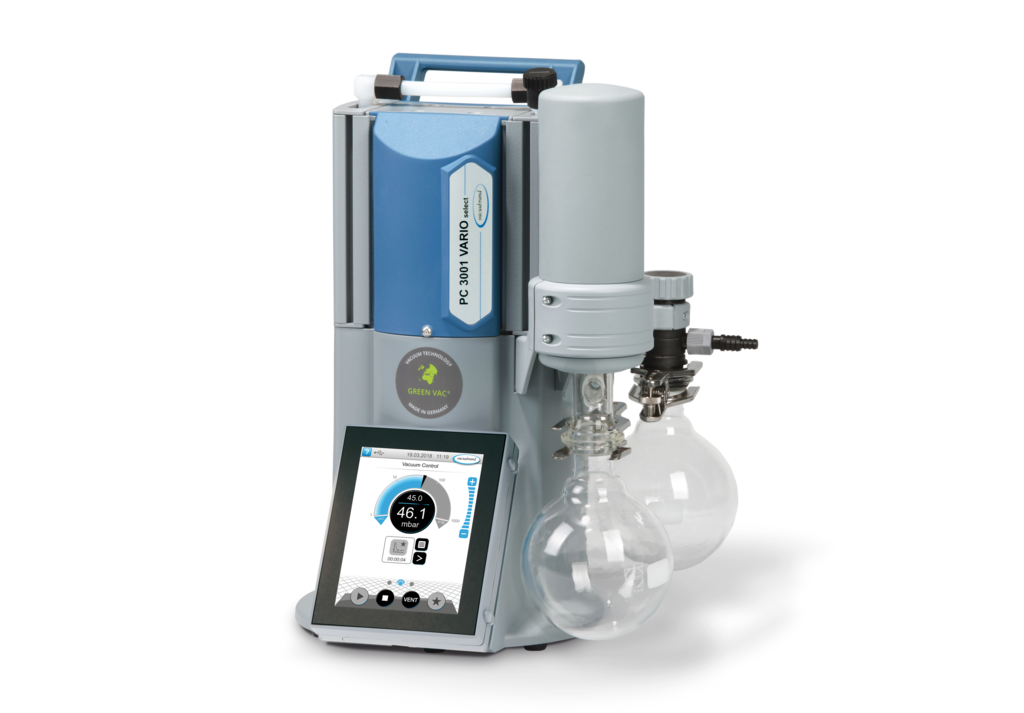
- Choose local options over central systems for vacuum generation: Local vacuum supply – whether by individual pumps or by space- and energy-saving in-lab vacuum networks – permits the vacuum produced to be matched both to the vacuum conditions needed (improving scientific performance) and to the actual hours of use (reducing energy consumption and extending service intervals). Bench vacuum from local networks can even match the capacity of individual pumps, eliminating the duplication of central systems supplemented by dedicated pumps where deeper vacuum or better control are needed. The further advantage of local vacuum networks is the right-sizing possibilities and the adaptability they afford as building requirements change with science program and budget priorities. Unlike central systems, which often require overbuilding to accommodate all possible future needs, modular local systems can adapt as needs change.
- Use vacuum controls: Excess vacuum not only wastes energy, it also compromises the scientific operations. Solvents that should be filtered or aspirated are inadvertently evaporated. Solvents that should be evaporated and collected end up bumping and foaming and are pushed out through exhaust. Imprecisely controlled operations take longer to complete, extending run times. Complex operations need continuous oversight, wasting the most critical resource in the lab: scientist time. Electronic controls can eliminate all of these issues. The electrical demand of control is trivial compared with the motor demands of the pump, even as it contributes to pump and lab efficiency.
- Produce vacuum on demand: If specifying vacuum for an entire building, select pumping systems that can respond to overall building demand. (Be cautious to ensure that these pumps are also chemical resistant enough for lab buildings.) – Better than building-wide systems are smaller pumping networks that can respond to demand in a single lab. A building-wide system need not be activated when a single scientist needs to work nights or weekends, and the responding local pump is a smaller, more energy-efficient machine. Choosing pumps that detect vacuum demand on a local network can exactly match pumping with vacuum requirements. – Even single-user pumps offer energy saving options; pumps with speed-controlled motors can reduce energy use at a single vacuum workstation by 90 percent compared with single-speed, continuously operating pumps. Pumps that detect vacuum demand automatically and respond as needed can eliminate wasteful operations like continuous pumping for intermittent operations (such as liquid aspiration in cell culture) without the use of cumbersome foot-pedals.
- Collect waste vapors locally: Water-cooled condensers at the exhaust of local dedicated pumps, or vacuum pumps supporting local networks, can efficiently condense and collect waste vapors. Since most lab solvents are liquid at room temperature, systems that return these vapors to room temperature at the point of exhaust from the pump – where they return to atmospheric pressure – can easily capture vapors for recycling, reuse or proper disposal, rather than releasing them into the surrounding air through fume hoods and building exhaust fans.
Green VACUUBRAND
For decades, VACUUBRAND® manufacturing has emphasized waste minimization, pollution control, and reduced energy use. We recycle virtually all lubricants and production by-products. We capture rainwater for process and sanitary use and rely on natural light and natural convection cooling in factories and offices. Even as we test every pump before shipment, we capture waste factory heat for building and water heating. We have also been in the forefront in the design of environmentally responsible vacuum equipment.
Our vacuum gauges and controllers are mercury-free and cadmium-free. We were the first to introduce vapor capture accessories for lab pumps, and also pioneered energy-saving speed-controlled pumps that can reduce energy consumption by 90 percent even as they boost lab productivity. Our VACUU•LAN® local vacuum networks produce high-performance vacuum on demand and permit a single, quiet, in-lab pump to support as many as 16 users at once with vacuum on demand.