Pipetting Techniques for Accurate Results
An air displacement pipette, also known as an air cushion pipette, is a piston-operated instrument used to accurately aspirate and dispense
precise liquid volumes. The piston and liquid in the plastic tip are separated by an air cushion allowing for contamination-free liquid
handling. As the piston is moved up and down, a negative or positive pressure is created. This movement results in liquid being aspirated into or
expelled from the tip.
Air displacement pipettes are ideal for liquids with similar density, viscosity, and vapor pressure (volatility) to water. For slightly volatile, viscous, or
foaming liquids we recommend using the reverse pipetting technique. For highly volatile, viscous, or foaming liquids we recommend using a positive displacement instrument.
FORWARD PIPETTING
Aspirating the Sample
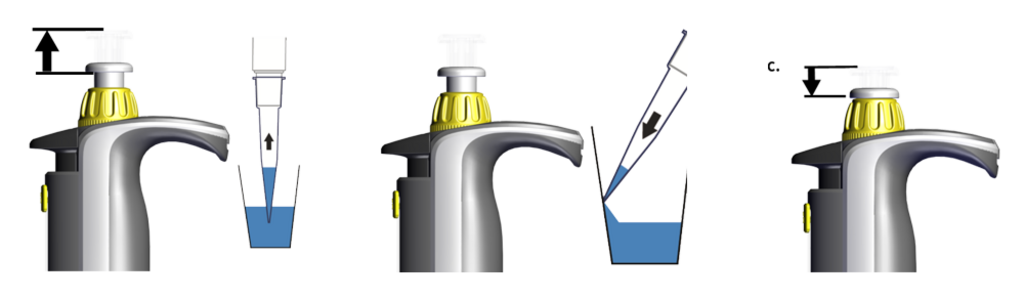
- Set the volume to be aspirated and on the pipette.
- Press the pipetting button to the first stop.
- Hold the pipette vertically and immerse the tip 1-4mm below the liquid surface. For larger volume pipettes (>1000μL) use an immersion depth of 3-6mm.
- Slowly release the pipetting button back to its original position.
- With tip immersed in liquid, wait several seconds until set volume is completely aspirated.
- The ISO8655 standard requires pre-wetting the tip once prior to performing the pipetting procedure additional technical information on ISO8655 calibration standards
Dispensing the Sample
- Hold the pipette at a 30-45° angle touching the wall of the container.
- Push the pipetting button to the first stop and hold.
- Push the pipetting button to the second stop (blow-out) while wiping the tip against the wall.
- Remove the pipette tip from the container, and then release the pipetting button back to its original position.
REVERSE PIPETTING
Aspirating the Sample
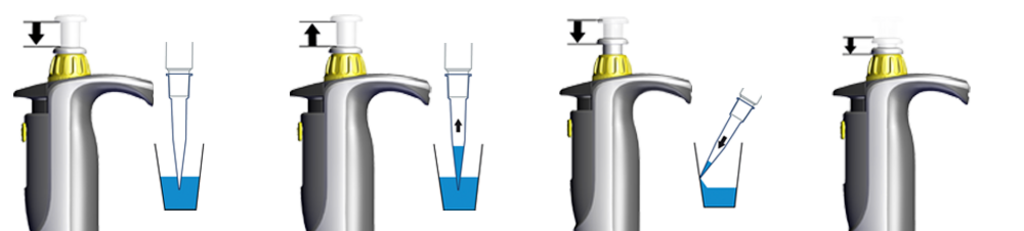
- • Pre-wet the tip 3-5 times by slowly aspirating and dispensing liquid in the tip (forward pipetting).
- • Press the pipetting button to the second stop.
- • Hold the pipette vertically and immerse the tip 1-4mm below the liquid surface. For larger volume pipettes (>1000uL) use an immersion depth of 3-6mm.
- • Slowly release the pipetting button back to its original position, paying attention to avoid bubbles in the tip.
- • With tip immersed in liquid, wait several seconds until set volume is completely aspirated.
Dispensing the Sample
- Hold the pipette at a 30-45° angle touching the wall of the container.
- Push the pipetting button to the first stop and hold for several seconds.
- Remove the pipette tip from the container while holding pipetting button at the first stop. (Note: Excess liquid will remain in tip and should not be dispensed)
- Excess liquid can be returned to original solution by pressing pipetting button to second stop or ejected with the tip.
PIPETTING TIPS
ACCURACY AND PRECISION
- Calibration is the process of determining the performance of an instrument without mechanical or electronic adjustment.
- Adjustment is the manipulation of the instrument post-calibration so that the instrument is aligned within the specified tolerances.
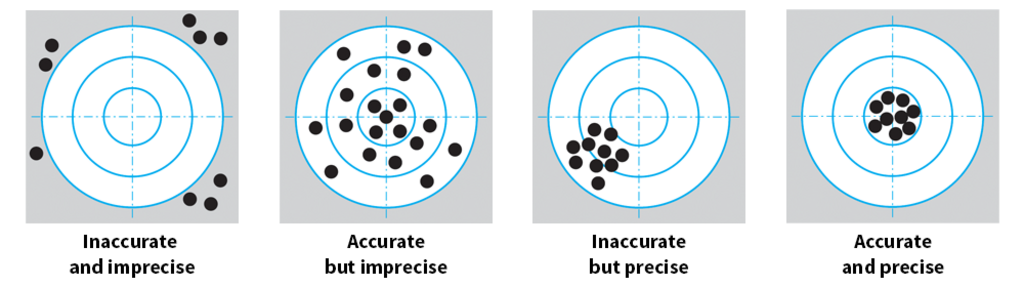
- Accuracy of measurement is how close the result comes to the target value.
- Precision (reproducibility) describes how closely grouped results are in a set of measurements, in units of volume.
BRAND QUALITY
BRAND Transferpette® S pipettes and BRAND tips are the ideal combination for quality and accuracy in pipetting. The precision workmanship, simple operation, and ergonomic comfort of the Transferpette S make it the performance standard in pipetting.
See more about the BRAND Transferpette family of Pipettes