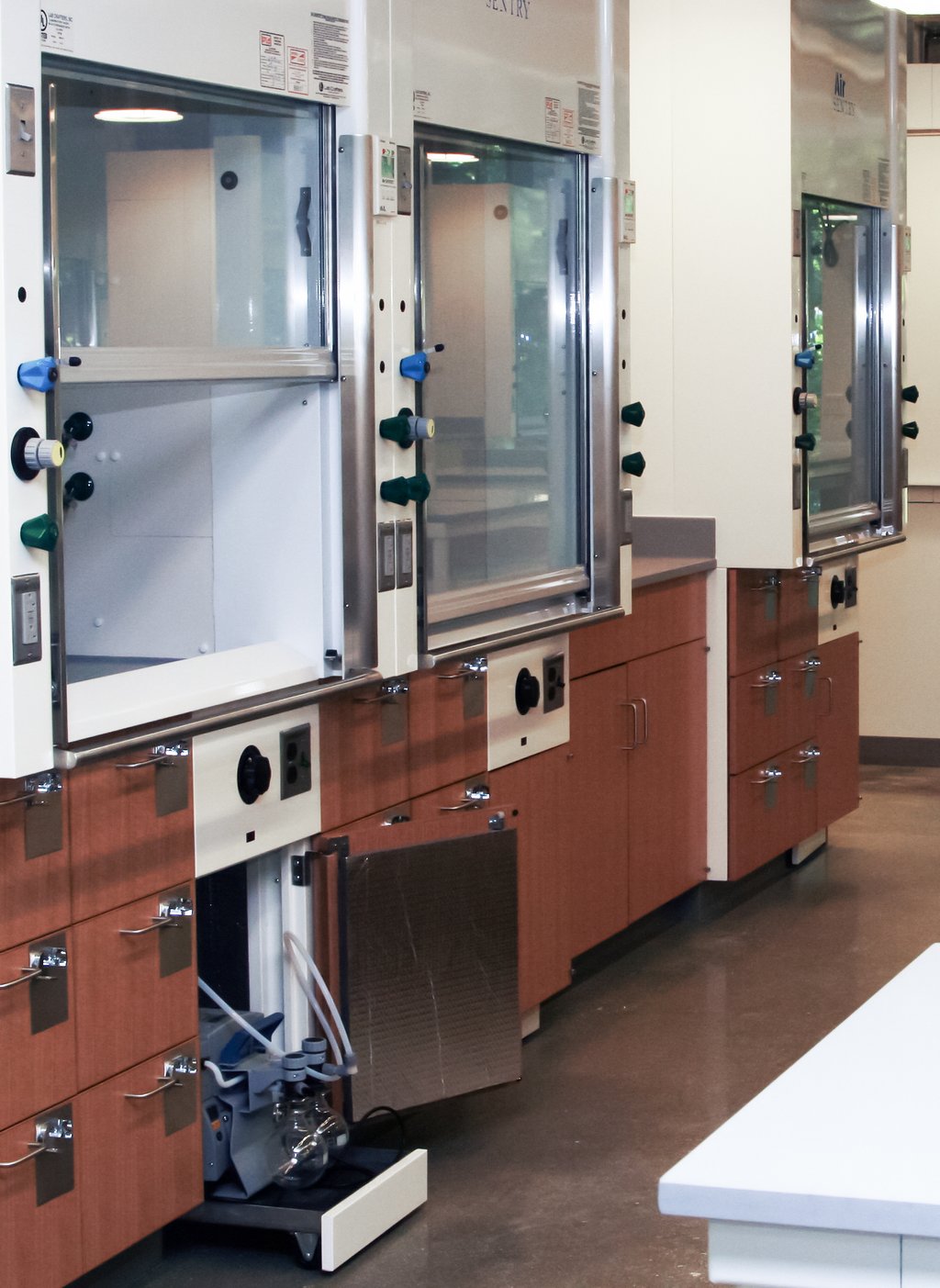
Replacing Water Jet Aspirators with VACUU·LAN® Lab Vacuum Systems to Improve Vacuum Performance at John Hopkins University
An aging infrastructure in Johns Hopkins University's Mergenthaler chemistry building created persistent flooding, unreliable vacuum performance, and severe water waste due to widespread use of water aspirators. With enrollment rising and a new Undergraduate Teaching Laboratories (UTL) facility planned, the university needed a water-free, adaptable, and high-performance vacuum solution. This case study highlights how a VACUU·LAN® lab vacuum system provided a reliable, energy-efficient, and environmentally responsible alternative to traditional water aspirators—supporting JHU’s teaching mission while reducing flooding and dramatically improving vacuum quality.
BACKGROUND
Built in the 1930s and last renovated in the 1980s, the Mergenthaler chemistry building housed the university’s introductory, organic, inorganic, and physical chemistry teaching laboratories. These labs collectively served more than 1,500 undergraduates annually—nearly one-third of the entire undergraduate student population.
To provide vacuum, the labs relied on over 150 water jet aspirators, each consuming up to 2 gallons per minute of domestic water. These aspirators operated during peak lab sessions, generating tens of thousands of gallons of water use each year and sending solvent-laden water directly into the waste stream.
As enrollments grew, the strain on both the plumbing infrastructure and the vacuum capacity became unsustainable.
THE PROBLEM: Flooding, Vacuum Failure, and Environmental Risk
Frequent Flooding and Building Strain
The ground-floor organic and physical chemistry labs routinely experienced water leaking from overflowing cup sinks in the labs above. Because aspirators required high-flow water, any sink blockage caused rapid overflow.
Deteriorating Vacuum Performance
With 60+ aspirators operating simultaneously during lab sessions, building water pressure dropped, leading to weak, inconsistent vacuum, experiment delays and failure and increased student and lab-staff frustration. The system simply was not engineered for the simultaneous, high-demand usage patterns of modern teaching labs.
Environmental and Safety Concerns
Solvent-laden vapors including dichloromethane and ether, were pulled directly into the wastewater stream. Faculty recognized the environmental impact and the liability associated with aspirator-based vacuum.
SEARCHING FOR A VIABLE ALTERNATIVE
At the same time, Johns Hopkins was planning a new Undergraduate Teaching Laboratories (UTL) building to consolidate teaching labs across biology, chemistry, biophysics, and neuroscience. Flexibility and sustainability were core design principles, and the architectural firm Ballinger was tasked with identifying systems that aligned with these goals.
During their research, Drs. Greco and Pasternack discovered that the University of Colorado had implemented VACUU-LAN lab vacuum systems, a decentralized approach using small, oil-free pumps placed within each lab rather than a building-wide central vacuum system. Ballinger engaged VACUUBRAND engineers for a detailed review of JHU’s needs, including:
- Required vacuum depth
- Number of simultaneous users
- Flexibility for changing course curricula
- Elimination of water and solvent waste
- Compatibility with a highly flexible teaching lab layout
Tests on campus confirmed that filtration-depth vacuum (55 Torr / 28 in. Hg) was sufficient for JHU’s undergraduate curriculum. Following demonstrations with university staff and contractors, the university selected VACUU·LAN systems for general chemistry, organic chemistry, and advanced inorganic labs.
SOLUTION: Installation of VACUU·LAN lab vacuum system
The VACUU-LAN system provided several advantages:
- Reliable, On-Demand Vacuum— Oil-free pumps deliver consistent vacuum regardless of how many students are using the system.
- Eliminates Water Usage and Contamination— No more sending solvent vapors into wastewater—and no more aspirators running gallons per minute.
- Modular and Flexibly Scalable— Each lab can be modified, expanded, or reconfigured without building-wide downtime; perfect for modern teaching environments.
- Minimal Maintenance— Oil-free, corrosion-resistant pumps dramatically reduce service demands compared with central systems or dozens of individual pumps.
- Flood-Free Labs— Removing aspirators eliminated the plumbing overloads that caused decades of flooding.
RESULTS: A Dry, High-Performance, Energy-Efficent Teaching Facility
The 105,000 GSF Undergraduate Teaching Laboratories building featured:
- 20 teaching labs across three floors
- Energy-efficient design and occupancy-controlled HVAC
- Highly flexible labs with modular casework and open lab layouts
- A sweeping glass façade bringing natural light to all teaching spaces
Performance of the Lab Vacuum Systems
Faculty report significant improvements
- “Much more reliable vacuum” that consistently meets experimental needs
- No solvent contamination of water supplies
- Significant water savings, eliminating tens of thousands of gallons annually
- No flooding events, resolving the chronic infrastructure failures of the past
- Near-zero maintenance, aside from one pump damaged during a lightning-related power surge
The networks support JHU’s sustainability goals and contribute toward LEED certification.
CONCLUSION: A Greener, More Reliable Future for Teaching Labs
By transitioning from water aspirators to a VACUU·LAN® lab vacuum system, Johns Hopkins University:
- Eliminated chronic flooding and infrastructure failures
- Dramatically reduced water use and environmental impact
- Improved the reliability and quality of lab vacuum
- Enhanced student safety and learning experience
- Gained long-term adaptability for evolving scientific education
The Mergenthaler building’s chronic problems offered a compelling case for change; the UTL building’s performance demonstrates the lasting value of modern, decentralized vacuum technology in academic science facilities.