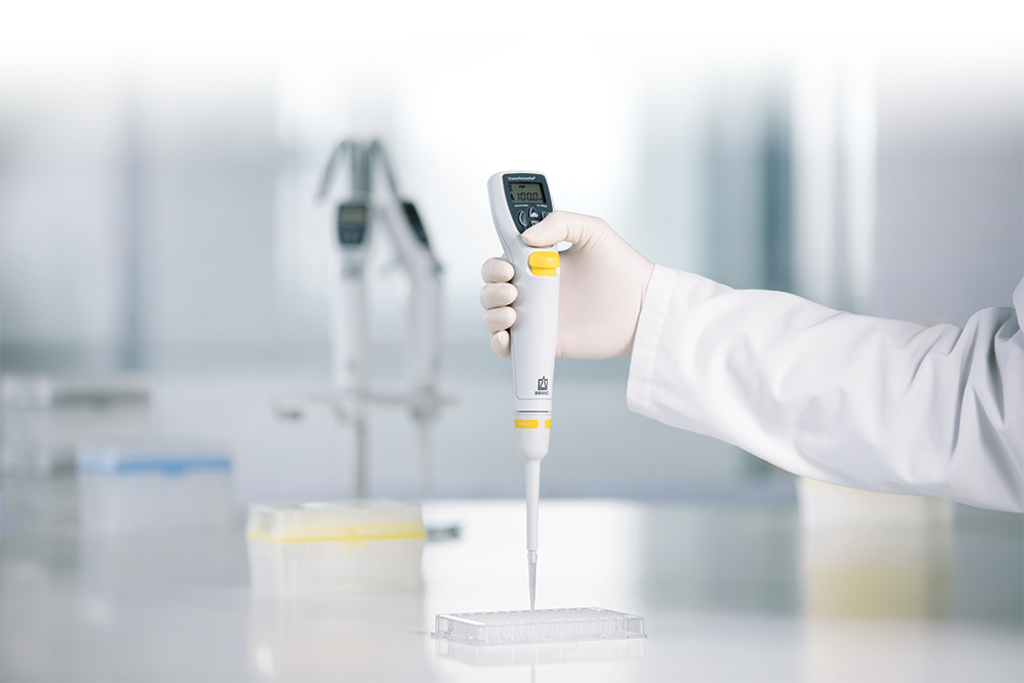
Selecting the Proper Pipette For Maximum Accuracy
One of the most frequently used tools in a typical laboratory is the air-displacement, or air-cushion pipette. They are convenient, easy-to-use, and in conjunction with single use pipette tips, minimize the chance of cross contamination between samples. But do you know how to select the correct- sized pipette for maximum accuracy? To do so, we need to look a bit at the mechanics of the instrument.
In concept, an air displacement pipette is a fairly simple apparatus. They operate by having a piston of consistent diameter pushed through a seal to move a column of air. This air movement, in turn, moves the liquid to be measured into and out of a disposable pipette tip. With an air displacement pipette, the liquid should never touch the pipette itself. There should always be an air cushion in the tip between the liquid and the end of the pipette. Once a tip is attached, the piston is moved forward from its resting position through the piston seal to push air out of the pipette. The tip is then immersed just below the surface of the liquid to be aspirated and the piston is allowed to return to its resting position, via a spring. This creates a vacuum in the pipette tip and atmospheric pressure pushes the liquid into the tip. For an adjustable volume model, the stroke length is varied – to achieve a volume 50% of the nominal capacity, for example, the stroke length is halved. A screw mechanism is used to adjust precisely the distance the piston travels – you can tell a lot about the quality of a pipette by the operation of this mechanism.
For pipettes with nominal volumes of 100 μL or greater, the inaccuracy of an air displacement pipette can be thought of as a constant volume that holds constant throughout the range of the instrument. ISO 8655 part 2 lists this value at ≤± 0.8% of the nominal capacity (i.e., ≤± 0.8 μL on a 100 μL instrument). This number mostly has to do with the mechanics of the instrument. For smaller volumes, the volume of inaccuracy increases, due to a number of factors, the largest of which is the compressibility of air. Typically, when looking at a pipette data sheet or catalog, the accuracy is presented as a percentage of the nominal volume with no additional information provided. It is up to the user to determine the implications.
When estimating the accuracy percentage for partial volumes, the numerator—the volume of inaccuracy remains the same, it’s the denominator—the set volume, that changes.
Accuracy of a 100 μL pipette at partial volums
| Volume Setting, μL | Percentage of nominal capacity | Volume of inaccuracy, ≤± μL | Accuracy percentage of pipetted volume, ≤± | |
|---|---|---|---|---|
| 100 | 100% | 0.8 | 0.8% |
|
| 75 | 75% | 0.8 | 1.1% | |
| 50 | 50% | 0.8 | 1.6% | |
| 20 | 20% | 0.8 | 4% | |
| 10 | 10% | 0.8 | 8% | |
What should be clear from the chart is that an air displacement pipette is most accurate when it is at, or close to its nominal capacity. Furthermore, that accuracy drops off rapidly once the set volume goes below 50% of the nominal capacity. This is the reason that pipettes have a stated volume range – providing not only an upper volume limit, but a lower volume limit as well.
In a well-equipped lab, pipetted volumes often fall somewhere within the volume ranges of several pipettes. For example, 20 CL could be measured with 2–20μL, 5–50μL, or 10–100μL pipettes. Naturally the volume would be most accurately be pipetted with the 2-20μL instrument. However, if that instrument is unavailable, you will always be more accurate choosing an instrument with the lowest volume relative to your volume. In this case, the 5–50μL pipette is a better choice than the 10–100μL pipette. If your lab is less well-equipped, with pipettes of only marginally overlapping ranges available, selection of one or two additional instruments can often greatly increase the accuracy of your measurements.
BRAND offers air displacement pipettes in both manual and electronic versions. The BRAND Transferpette S is a manual single channel air displacement pipette and is available in ten different adjustable volume sizes (0.1-1μL up to 1-10mL) to cover nearly the entire range from 0.5 μL to 10mL by only using the upper halves of the pipettes’ ranges. Similarly, the Transferpette -8/-12 is a manual multichannel pipette available in five different adjustable volume sizes (0.5-10μL to 30-300μL) for similar results for 1 μL to 300μL.
The BRAND Transferpette electronic is also an air displacement pipette. It too is available in single channel and multichannel (-8/-12) models, and adjustable volume ranges. Five different single channel Transferpette electronic instruments cover volume ranges from 0.5-10μL up to 250-5000μL, while five different volume ranges for the multichannel model cover volume ranges from 0.5-10μL up to 15-300μL