VACUU•LAN® local vacuum networks for your… Biological Containment Suite
Application Note
The Challenge: Contained, space- efficient vacuum
When you are building Biosafety Lab (BSL) space, and some of your applications require vacuum support, how do you maintain containment and provide cost-and space-efficient vacuum?
A central vacuum system could provide the vacuum, but your objective is to contain biological materials; the central vacuum could suck them out of the BSL space into the building-wide piping, risking cross-contamination. An individual oil-free, diaphragm vacuum pump is a good choice if you have a single application. The right oil-free pump will run clean and quiet. But what if you have several applications that need vacuum? Do you really want to fill precious biocontainment lab space with multiple pumps?
Consider a VACUU•LAN local vacuum network
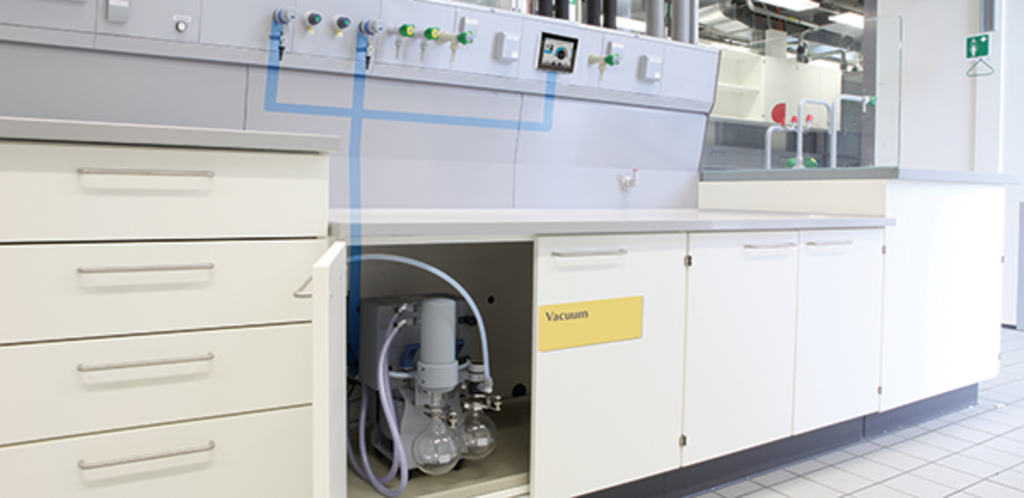
A VACUU•LAN local area vacuum network bridges the gap between dedicated vacuum pumps for each user and central vacuum systems. In biocontainment space, you install the entire VACUU•LAN network – the whisper-quiet oil-free pump and several vacuum ports – within the lab. Networks can deliver differentiated vacuum simultaneously to applications with different vacuum requirements. VACUU•LAN networks are adaptable over time; you can add or reconfigure vacuum workstations as needed. And the isolation of one lab vacuum network from another protects against cross-contamination through a building-wide vacuum network.
You get the economies of multi-user vacuum supply, and the performance advantages of dedicated vacuum pumps, plus containment, adaptability and space-saving efficiency.
With a VACUU•LAN network:
- One compact, whisper-quiet, oil-free pump serves four to sixteen workstations.
- Check valves on the network isolate applications from one another, controlling pressure spikes that can lead to cross-contamination.
- Your network is installed quickly using only light tools – no soldering, brazing or expensive hard piping is needed – and can be expanded or reconfigured later.
- You install only what you need, when you need it, maximizing economy and adaptability.
- You can choose the amount of control you need, from on-off, to manual flow-control to full electronic control…at each port at any time.
- Service demands are minimal; first recommended service is after 10-15,000 hours in normal use. That’s years for most labs, and pump service can be done in the lab with light tools in an hour or less