Lab Equipment for Pulp and Paper Laboratories
Pulp and paper laboratories perform a wide range of chemical analyses that require precise, chemically resistant instrumentation. Testing environments regularly involve aggressive reagents, trace-level contaminants, and high-volume repetitive workflows. Selecting the right liquid-handling instruments and solutions for these demands, from titration and reagent dispensing to filtration and volumetric measurement, directly affects the accuracy and reproducibility of results.
For more information on BRANDTECH lab supplies commonly used in this market, refer to our Pulp and Paper Tools PDF.

Applications in Pulp and Paper Laboratory Testing
Sulfur Dioxide and Chemical Oxygen Demand Analysis
Sulfur dioxide (SO2) titrations and chemical oxygen demand (COD) testing are among the most common analyses performed in pulp and paper labs. Both require accurate, repeatable delivery of titrant volumes using a burette and reliable endpoint detection to produce valid results across daily testing cycles.
Reagent Preparation and Dispensing
Process chemicals, including sodium hydroxide, potassium permanganate, sulfuric acid, and hydrochloric acid, are used regularly in pulp and paper testing. A reliable bottle top dispenser or reagent bottle dispenser that resists chemical corrosion and maintains volume precision is essential for safe, accurate daily use.
Trace Metal and High-Purity Analysis
Monitoring trace metal concentrations in process water, pulp, and finished paper products is critical for quality control and regulatory compliance. These analyses require labware and dispensing equipment free of leachable metals to prevent contamination that could compromise results at the parts-per-billion level.
Filtration and Vacuum Applications
Sample preparation for many pulp and paper analyses involves filtration to remove suspended solids before measurement. A consistent vacuum aspiration system or lab vacuum system is needed to support reproducible filtration rates without introducing variability between samples.
General Volumetric Work and Sample Handling
Serial dilutions, sample aliquoting, and reagent transfers are routine tasks in any analytical lab. Proper pipetting technique and ergonomic pipettes that minimize operator fatigue support consistent results across high-volume workdays.
Reagent Dispensing
Consistent, accurate dispensing of laboratory reagents is fundamental to reliable analytical results. In environments where concentrated acids, bases, and solvents are handled daily, a bottle top dispenser must maintain chemical resistance without sacrificing volume accuracy. The ability to recirculate the reagent back to the reagent bottle also reduces waste and minimizes the risk of splashing during dispensing. For labs working with organic solvents, a dedicated solvent bottle dispenser rated for aggressive chemicals is essential.
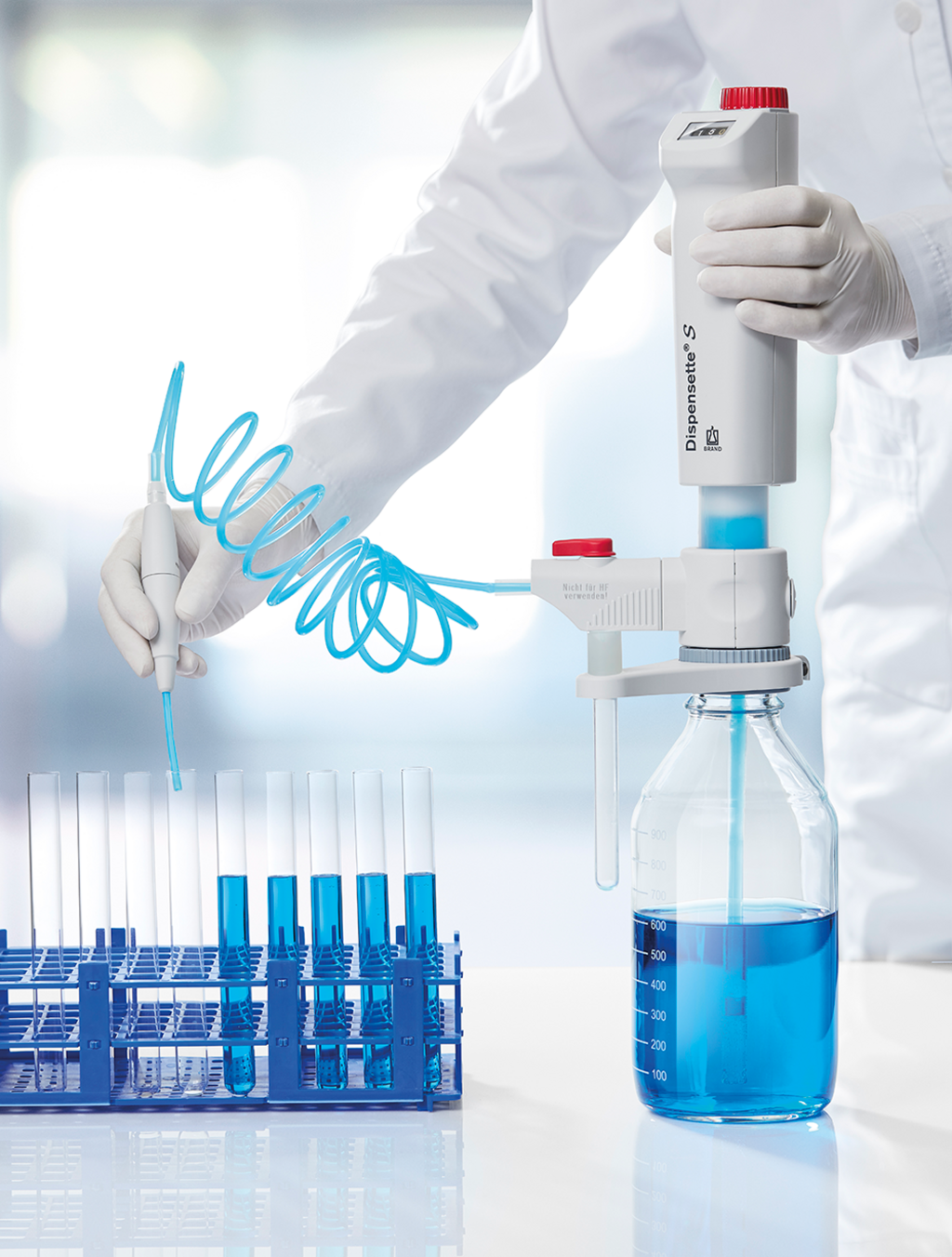
The Dispensette® S bottletop dispenser is designed for use with most common laboratory reagent bottles. For labs working with concentrated acids and solvents, including nitric, hydrochloric, sulfuric, and trifluoroacetic acid, the Dispensette S Organic provides the necessary chemical compatibility. Both models are straightforward to clean and calibrate, and are available with an optional recirculation valve. For applications involving high-purity reagents or hydrofluoric acid, the Dispensette S Trace Analysis dispenser is available separately. Analog-adjustable models span volumes from 0.1 mL to 100 mL. Digital and fixed volume configurations are also offered.
Liquid Sample Preparation
The accu-jet® S pipette controller is a practical fit for routine liquid sample preparation in a pulp and paper laboratory, particularly where staff repeatedly use glass or plastic pipettes to transfer samples, prepare dilutions, or add reagents. It accommodates pipettes from 0.1–200 mL.
These are potential applications based on the instrument’s capabilities; suitability depends on the laboratory’s test methods and liquids.
Transfer measured sample volumes and prepare dilutions for chemical analysis or biochemical oxygen demand (BOD) testing. BOD methods can require dilution before incubation.
Measure liquid dye solutions into laboratory pulp trials and prepare standards for spectrophotometric analysis. For example, a Canadian pulp dye-retention procedure calls for adding 20 mL of dye solution
Transfer liquid aliquots into test vessels or prepare dilutions for evaluating dissolved components, where the method specifies pipetting.
Measure stock solutions and reagents into volumetric flasks or reaction vessels for routine quality-control testing.
Routine Lab Pipetting
Accurate pipetting is central to sample preparation, dilution series, and reagent additions throughout the lab. Ergonomics matter in high-throughput environments where pipetting techniques are applied repeatedly over the course of a workday. Key factors in pipette selection include volume adjustment ease, stroke length, tip compatibility, and how well the instrument fits in the hand. An ergonomic pipette reduces strain during repetitive use.
The BRAND® Transferpette® S single-channel pipette is an ergonomic pipette featuring thumb-tip volume adjustment that works even with gloves, a short stroke length to reduce repetitive strain, and a slim lower barrel that reaches the bottom of 15 mL conical tubes. Available in capacities from 0.1 µL to 10 mL.
Multi-Dose Dispensing
When the same volume needs to be dispensed multiple times in succession, a repeating pipette improves both speed and consistency compared to a standard pipette. This is particularly useful for distributing reagents across a series of tubes or preparing aliquots. Mechanical repeater pipettes offer simplicity and reliability, while electronic models add touchscreen control for added convenience.
The HandyStep® S repeating pipette is a mechanical repeater pipette designed for comfortable one-handed operation and compatible with third-party tips. The HandyStep touch and HandyStep touch S are electronic repeater pipettes with touchscreen operation and automatic tip size recognition for BRAND PD-Tip IIs, while also accepting third-party tips.
Liquid Handing Measurment and Volumetrics
Plastic Labware for General Use
Plastic labware reduces the risk of breakage in active laboratory environments without sacrificing volumetric accuracy. For pulp and paper labs that require certified measurement vessels, Class A volumetric flasks and Class A graduated cylinders in plastic provide a durable alternative to glass. VITLAB plastic labware includes volumetric flasks, graduated cylinders, beakers, bottles, funnels, and scoops.
PFA Labware for Trace Analysis
Trace metal analysis requires labware that does not introduce contamination from the vessel itself. Materials must be resistant to both heat and chemical attack, and must not leach metals at any measurable level. PFA (perfluoroalkoxy alkane) labware meets these criteria, offering a non-reactive surface that simplifies cleaning between uses and supports the integrity of trace-level measurements. BRANDTECH PFA Trace Analysis labware is suitable for applications where standard plastic or volumetric flask glass alternatives may compromise results.
Vacuum and Filtration
Compact Vacuum Pumps for Laboratory Filtration
Laboratory filtration requires a vacuum technology source that delivers consistent performance across single and multiple filtrations. Important considerations include pumping speed, ultimate vacuum level, chemical resistance, and the physical footprint on the bench. A chemical diaphragm pump is often preferred over a rotary vane pump in labs with acid vapors due to its dry, corrosion-resistant operation. A vacuum controller or vacuum regulator valve allows fine-tuning of vacuum levels for sensitive applications.
The VACUUBRAND® ME 1C vacuum pump is a compact diaphragm pump vacuum with a full fluoropolymer flowpath for resistance to acid vapors. It delivers 14 lpm pumping speed and 100 mbar ultimate vacuum, and operates quietly with low vibration. An optional vacuum regulator with gauge allows variable adjustment of pumping speed for applications that require controlled filtration rates.
BRANDTECH Scientific & Instrumentation for Demanding Lab Environments
Pulp and paper laboratories work with a broad range of aggressive chemicals, perform analyses at trace concentration levels, and rely on instruments that perform consistently across high-volume workdays. BRANDTECH Scientific offers a portfolio of liquid handling instruments and general laboratory products selected and validated to meet these demands. Products carry recognized quality certifications, are built for long-term durability, and are backed by technical support to help labs identify the right instruments for their specific applications.
