Small-scale automatic robot handling line for molecular pathogen diagnostics
Application Note: Liquid Handling Station
Here we present an integrated small scale fully automatic diagnostic robot handling line for the purification, detection, and quantification of human pathogens. First, sample barcodes were scanned, and nucleoid acids were purified with the Roche MagNA Pure 24 system. For the PCR setup a modified version of BRAND’s Liquid Handling Station (LHS) with new Middleware in combination with an new LHS control software was established. This specific software package can automatically setup PCRs with up to eleven different Master-mixes on one plate. Furthermore, it adds all control reactions to the PCR setup and creates a PCR plate layout, which can be loaded into the LightCycler 480 software. The automatic sample barcode pass through, and the PCR setup helps to avoid sample mix-up while pipetting with the LHS ensures a reproducible and pipetting error-free sample amplification. Besides, the automatic robot handling line frees precious technicians’ labor time, reducing laboratory sample costs.
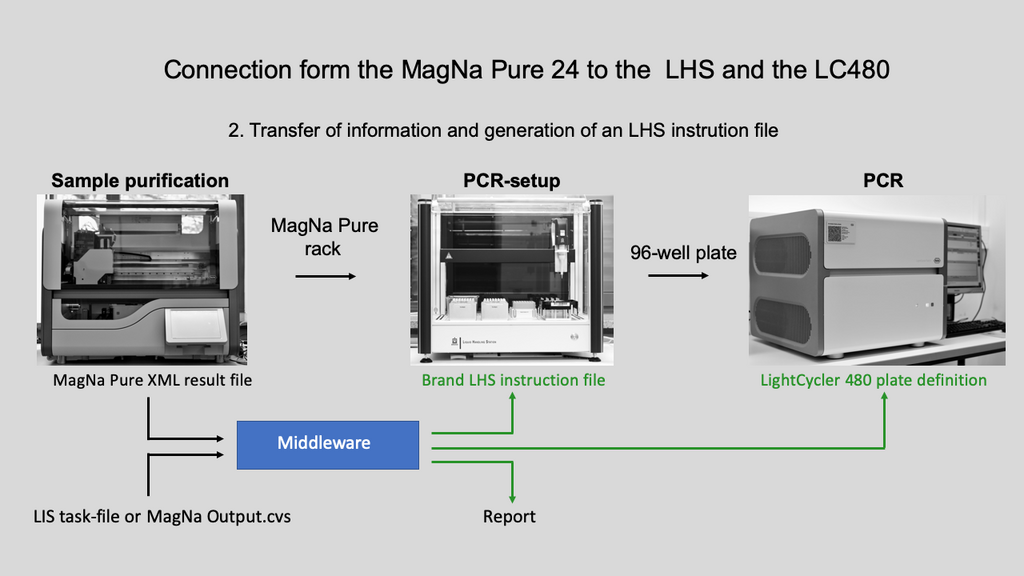
Detection of pathogens and determination genome amounts by qPCR or RTqPCR are standard tools in molecular diagnostics. Recently, complete automatic diagnostic systems, which purify and detect pathogens in high throughput scenarios, such as blood bank tests, were brought to market. However, small systems for less than 25 samples were not available and forced diagnostic laboratories to setup PCR reactions by hand. This project aims to establish a small scale fully automatic robot handling line for diagnostic laboratories by linking an RNA/DNA purification system to a pipetting robot for PCR preparation and finally to a qPCR-cycler (Figure 1).
The Roche MagNa Pure 24 system was selected as a fully automatic nucleotide acid purification system, which is capable of tracking sample ID and barcodes. Furthermore, it can be integrated into the lab information system and delivers result files back to the system. The Liquid Handling Station (LHS) from BRAND was chosen as a pipetting device for the PCR setup. Due to its small size, it helps saving lab space, and since it contains just a few moving parts, it provides low maintenance costs. Both, the MagNa Pure 24 and the LHS are walkaway devices, which on the one hand free technicians’ labor time and on the other hand, ensure high reproducibility of sample purification and of the PCR setup. Finally, the Roche LightCycler 480 was selected as diagnostic PCR Cycler with six different channels to perform complex diagnostic multiplex PCRs. Roche LightMix® Modular assays were chosen as PCR reagents, due to their extensive collection for the diagnostics of all significant pathogens.
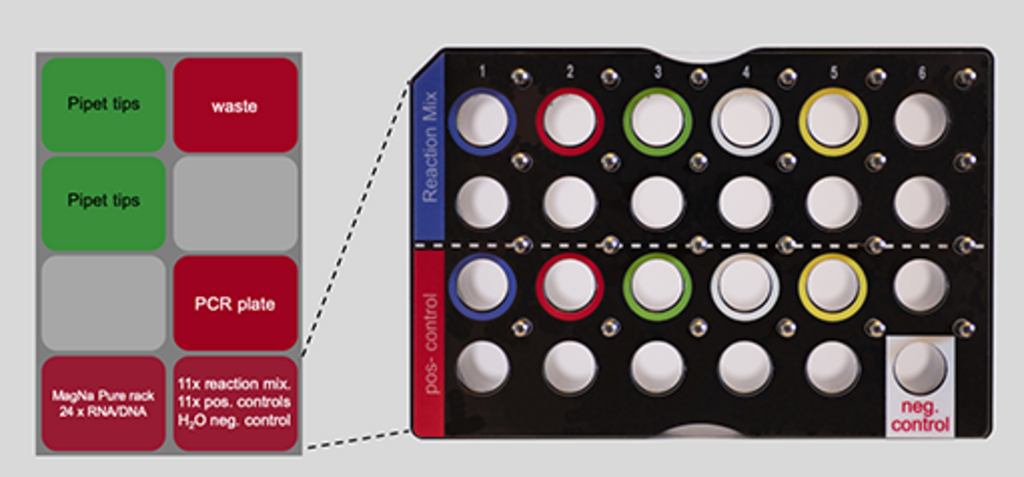
To standardize the LHS setup and to avoid incorrect operations, fixed positions for the pipette tip racks, for the sample racks and the PCR reaction mixes were defined (Figure 2). Furthermore, the areas of the PCR reaction mixes, positive and negative controls were defined and color-coded within the "PCR reaction-mix"-rack (Figure 2). The color-coding allowed the selection of similar col-ored tubes available from BRAND and included in the Roche edi-tion of the LHS for PCR mix setup. The match of the tube and adapter colors will further reduce the risk of tube misplacement. The volume of the positive reaction was set to 23 μl, whereas the negative control contains 100 μl of PCR water. This allows the storage of pre-mixed positive controls and negative controls. With this setup, the 24 samples of a single MagNa Pure run can be analyzed in up to eleven distinct multiplex PCR reactions on one plate offering unique flexibility for the PCR setup.
First analyses showed that two layers of connections from purification to amplification had to be established. First, the risk of sample confusion during sample transfer from the MagNA Pure to the LHS system and from the LHS to the LightCycler had to be eliminated, and secondly, automatic LHS programming and the LC480 plate layout using the MagNa Pure output files had to be created.
The second line of connection is mediated by the middleware software package. The pilot program was created by an external software engineer (Sebastian Arnd, software engineer, Berlin). The goal of the software development was to generate an instruction file for the LHS based on the MagNa Pure output file, a test definition-file, and a task file, in which the test request for the individual samples are defined. Both the test and the task-file were kept as simple as possible. The test-definition-file is not accessible by the user but can be adapted by system administrators. The software creates two output files. The first is used by the LHS control software and defines the pipetting steps (Figure 1). Furthermore, positive and negative controls are automatically added by the software to all PCRs used in the PCR-setup. The second output file is transferred to the LightCycler480 control computer and defines the plate layout for the PCR analyses. Also, the software calculates the amounts of PCR mixes and provides this information to the user. In summary, the new middleware software automatically creates a robot control file, adds all necessary controls, and generates a LightCycler480 plate layout (Figure 1).
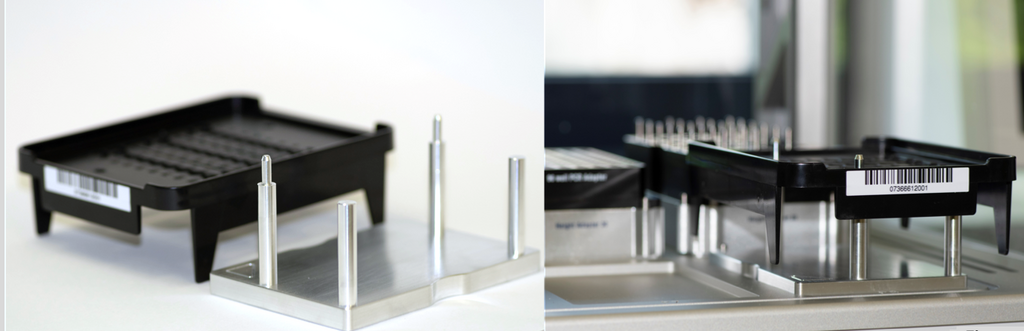
To eliminate sample mix-up inadvertently during the transfer from the MagNa Pure to the LHS a new LHS adapter, which allows placing the MagNa Pure elution rack directly in LHS, was constructed by BRAND (Figure 3). With this adapter, the MagNa Pure sample rack containing three 8-well strips can be used for the setup of the PCR reactions. These reactions are directly pipetted into a Roche 96-well PCR plate.
The second line of connection is mediated by the middleware software package. The pilot program was created by an external software engineer (Sebastian Arnd, software engineer, Berlin). The goal of the software development was to generate an instruction file for the LHS based on the MagNa Pure output file, a test definition-file, and a task file, in which the test request for the individual samples are defined. Both the test and the task-file were kept as simple as possible. The test-definition-file is not accessible by the user but can be adapted by system administrators. The software creates two output files. The first is used by the LHS control software and defines the pipetting steps (Figure 1).
Furthermore, positive and negative controls are automatically added by the software to all PCRs used in the PCR-setup. The second output file is transferred to the LightCycler480 control computer and defines the plate layout for the PCR analyses. Also, the software calculates the amounts of PCR mixes and provides this information to the user. In summary, the new middleware soft-ware automatically creates a robot control file, adds all necessary controls, and generates a LightCycler480 plate layout (Figure 1).
To optimize the LHS to the LightMix® Modular Respiratory Syncytial kit or Influenza kit, we used viral RNAs from cell culture supernatants from either RSV or Influenza virus-infected cells and modulated the uptake velocity. All reactions were performed 6times from the same RNA on the Roche LightCycler480 qPCR machines. Quality of the RTqPCRs was ensured by following the MIQE guidelines [Bustin, S. A. et al. (2009). The MIQE Guidelines: Minimum Information for Publication of Quantitative Real-Time PCR Experiments. Clinical Chemistry, 55, 611–622. doi.org/10.1373/clinchem.2008.112797)].
In brief: First, the recursion coefficient of the relative-standard curve r2 had to be >0.95. Second, sixlett assays with a standard deviation of >0.5 were excluded from the analyses. The settings of the LHS parameters for pipetting were optimized for Roche LightMix® Assays. At the optimal uptake velocity of 0.8 mm/s, the standard deviation of the Cq value of the six-lett was determined below 0.2. The blowout velocity was optimized to 0.8 mm/s in similar assays. Also, the blowout during prewetting of the pipet tips was set to "blowout above liquid".
In the following trial period, more than 5.000 PCR reactions were pipetted in triplet assays to analyze to determine the standard deviation of the Cq values. This standard deviation was always 0.2 > standard deviation > 0.05 showing the precision of the PCR setup. Our quality control assays also included PCRs in a checkerboard pattern, where positive and negative alternate on the PCR plate to analyze DNA/RNA contaminations during PCR setup. Again, RSV with a Cq of less than 18 was used as positive samples. Also, we either used the Influenza virus alone or in multiplex PCRs with RSV, but we never observed any contamination by the LHS in all assays analyzed.
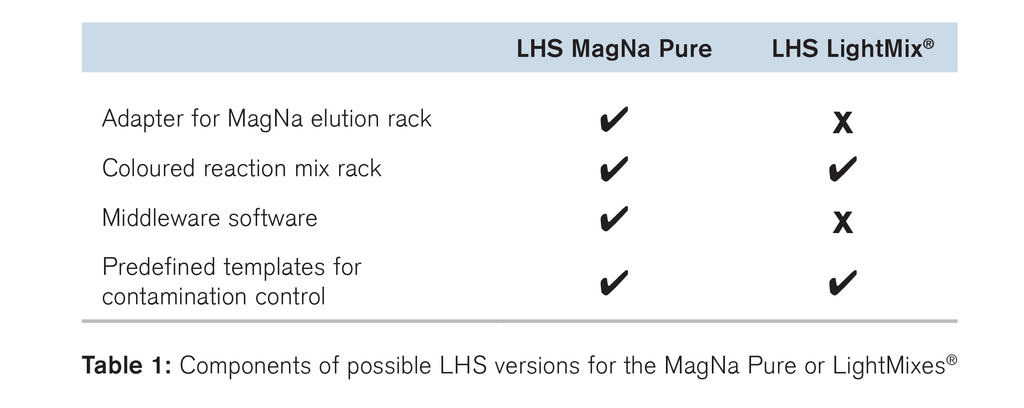
In conclusion, a modified version of the LHS closes the gap between nucleoid acid purification and amplification with the LightCycler 480. Two different version of the LHS (Table 1) could be considered with all required material including a modified block for PCR mixtures, and in case of a MagNa Pure version the sample rack adapter, and the middleware software package should be included.
Authors: Luisa Kirschner, Melissa Immerheiser, Jochen Bodem
Institute of Virology and Immunobiology, Julius-Maximilians-Universität, 97078 Würzburg Sebastian Arnd, Software engineer, Kolonie Str. 39, 13359 Berlin